ISCM World New Music Days 2026: Columna Infinita in Bucharest
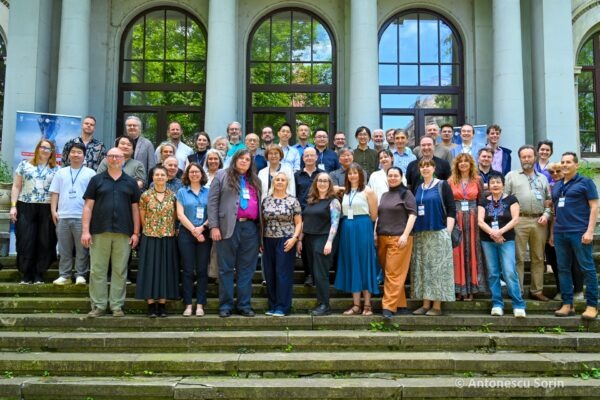
Since 1923, the International Society for Contemporary Music (ISCM) has, with only a few rare exceptions, gathered each year in a different location for a truly unique festival. From 23 to 31 May 2026, dozens of composers, performers, and musicologists from the worldwide network converged on Bucharest, Romania, for Columna Infinita, a fabulous musical journey curated by Dan Dediu and Diana Rotaru.
The ISCM World New Music Days are always an overwhelming experience, even for seasoned ISCM delegates: the impressions of a new city, the General Assembly (amounting to some fourteen hours of meetings), countless new encounters, the joy of reconnecting with friends from around the world, and, of course, a wealth of concerts. My work on the ISCM Executive Committee and my role as Vice-President add yet another layer to this experience—along with many additional hours of meetings. Not to mention the slight nervousness that accompanies the thought that we—the ISCM Flemish Section and the ISCM Wallonia–Brussels Federation Section—hope to bring the festival to Brussels in a few years’ time.
The World New Music Days invariably present very recent works from every corner of the globe. The Romanian festival organisers succeeded brilliantly in capturing this broad panorama through exceptionally well-curated programmes, skilfully combining works selected through the international Call for Works with music by major figures from the Romanian contemporary music tradition and compositions by ISCM Honorary Members. These various strands came together magnificently in the concert given by the George Enescu Philharmonic Orchestra under the direction of Gabriel Bebeşelea (27 May, Romanian Athenaeum). The orchestra opened with the Concert Overture on Romanian Folk Themes by Romania’s national hero George Enescu (whose portrait even appears on banknotes), and naturally Bartók and Ligeti were also represented, the latter with the Romanian Concerto (1951). We heard Dan Dediu’s Levante, and members of the orchestra performed short pieces by Kurtág and Xenakis’s delightful percussion solo Rebonds B. The poignant Let Me Cry by the very young Eli Tausen á Lava, submitted by the ISCM Faroe Islands Section, completed the programme. The hall was full, yet one could have heard a pin drop.
During the festival, the ISCM General Assembly elected two new Honorary Members: Jane O’Leary and Doina Rotaru. Both have made outstanding contributions to contemporary music and to the ISCM community, but the election of Doina Rotaru—the grande dame of Romanian contemporary music—in her home country was an exceptional and deeply moving moment. On 27 May, the Radio Chamber Orchestra under Cristian Mandeal performed her violin concerto Himere in the Radio Hall, with Diana Moş as soloist, to whom the work is dedicated. I brought back a copy of the score for the MATRIX collection. In addition, I collected a substantial stack of CDs and scores by composers including Anatol Vieru, Dan Dediu, and Ştefan Niculescu—together accounting for several extra kilograms of luggage.
The remarkable violin playing of Diana Moş—who a few days later also gave an impressive recital featuring several works from the Call for Works—proved emblematic of the astonishingly high level of performers heard throughout the festival. Flautist Ion Bogdan Ştefănescu was equally impressive, both as a soloist and in ensemble settings, as were clarinettist Emil Vişenescu, pianist Adriana Maier, and Cătălin Răducanu on piano and cimbalom. The latter performed, among other works, Partita Ritardata for piano and live electronics by our compatriot Paul Pankert, submitted by our colleagues at Le Forum de la Création Musicale, the ISCM Wallonia–Brussels Federation Section. From the Flemish submission, the festival organisers selected CORO: VERSA EST IN LUCTUM, a tape composition by George De Decker. The work was warmly received, and the CDs made available by the composer quickly found their way into the hands of enthusiastic listeners.
As is customary, the World New Music Days also feature the presentation of the Young Composer Award, given to a composer under the age of thirty-five whose work has been performed during the festival. This year’s jury consisted of Jeffrey Stonehouse (Canada), Phoebus Lee (Hong Kong), and Irina Hasnaş (Romania), and their choice fell on the Greek composer Myrtó Nizami for her solo cello work Gone in No Time. Melissa Portaels already managed to secure a short interview with Myrtó. The Young Composer Award includes a commission for a future festival, and this year not one but two previous laureates were represented with newly commissioned works. Madli Marje Gildemann Sink (Estonia) received the award in 2023 for her piano quartet Osmosis (2020) and composed a new string quartet. Faux Flora was premiered on 24 May by the outstanding ARCADIA String Quartet. In 2024, the award went to Samuel Hvozdík (Slovakia) for his organ composition Magma (2021), performed by Hans Hellsten in Fuglafjarðar Kirkja (from 21’45”). In Bucharest, we heard the premiere of his Lichtmusik IV for choir and live electronics on 28 May, performed by the MADRIGAL – “Marin Constantin” National Chamber Choir under Anna Ungureanu. I spoke with both composers about their commissions; the interviews will appear soon on the ISCM website (www.iscm.org).
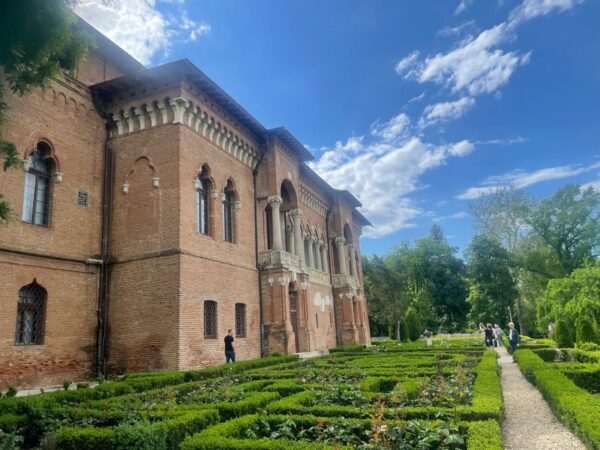
Mogoşoaia Palace
Finally, a significant part of the festival’s character is shaped by what happens outside the concert halls and meeting rooms. The legacy of Romania’s communist regime was an almost constant presence: from the view of the imposing and unsettling Palace of Parliament from our meeting room, to the countless monumental facades—some splendid, some crumbling—that dominate the cityscape, and the Museum of Contemporary Art, which confronts its complex history with openness and creativity. Adrian Iorgulescu’s opera Revoluţia likewise offered a fascinating glimpse into the complexities of that past.
Yet what remains most vivid in my memory is the time spent at Mogoşoaia Palace, with its magnificent gardens and fascinating tapestries; the warm hospitality and local cuisine (do try the sarmale—stuffed cabbage rolls—and the aubergine salad if the opportunity arises!); and the many, many conversations. Finally, Cişmigiu Park deserves special mention. Located close to the National University of Music, where the General Assembly and a substantial number of concerts took place, this nineteenth-century park regularly offered moments of tranquillity and relief from the heat. More than once, we returned there late in the evening, drawn by the frogs whose calls created unexpected music—sounds that inspired more than a few composers.
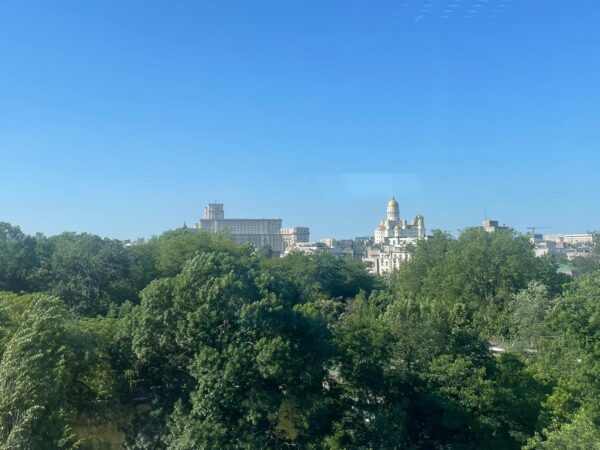
View from the meeting room
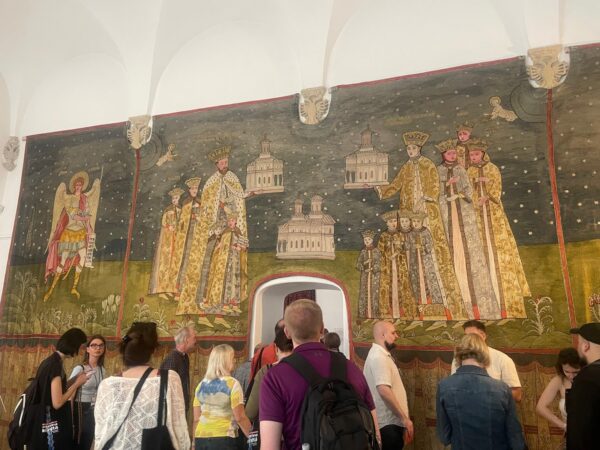
Mogoşoaia palace